
Peak season is around the corner. In a few weeks, a recruiter on your team will have forty new J-1 program inquiries sitting in their inbox, coming in through referrals, social media, and the agency’s website.
Somewhere in that pile is a lead who filled out an inquiry form ten days ago and never heard back. The recruiter won’t find out until the lead reaches out again, asking if the agency still has openings.
This peak season will look the same for you unless something changes. This is not one big crisis, just small ones piling up at once, with nobody sure who’s supposed to catch them.
Why Leads Get Lost During Peak Season
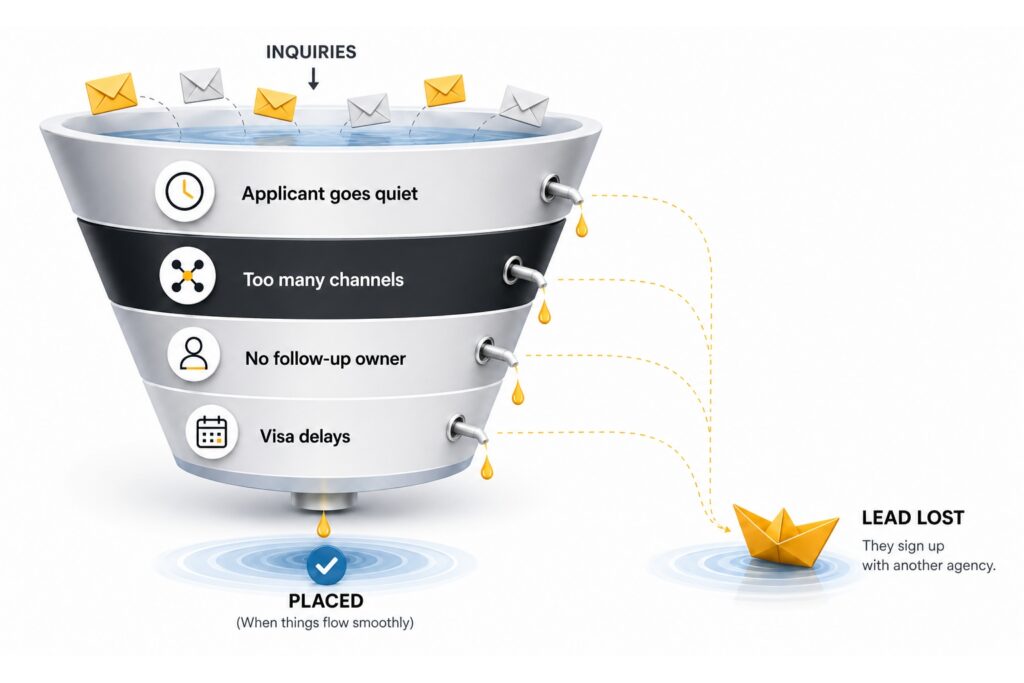
An applicant goes quiet, then disappears
An applicant gets stuck waiting on a background check clearance before their file can go to the sponsor for DS-2019 issuance, and nobody checks in. They email asking what’s going on, or worse, they just stop responding and sign up with another agency.
Leads arrive from too many channels
Leads come in from five or six different channels but none of these connect to one another, so nobody has one view of what’s actually coming in. A lead can sit untouched for days because it landed on a channel nobody was watching. Sometimes two recruiters reply to the same applicant from different channels. Each one assumed the other hadn’t.
Nobody owns the follow-up
Staff assignment happens by memory or a quick Slack message. That works fine in February. In June, when volume triples, everyone is juggling dozens of conversations, and a shared spreadsheet is the only record anyone has.
Visa delays shrink your window
J-1 Visa interview slots have gotten harder to book in countries like Thailand, Poland, Kazakhstan, and Turkey. Many BridgeUSA participants are at risk of missing their interview window this summer alone. That leaves less time to get an applicant approved before the sponsor can issue the DS-2019. A slow process now costs real placements.
How to Fix It Before Peak Season Hits
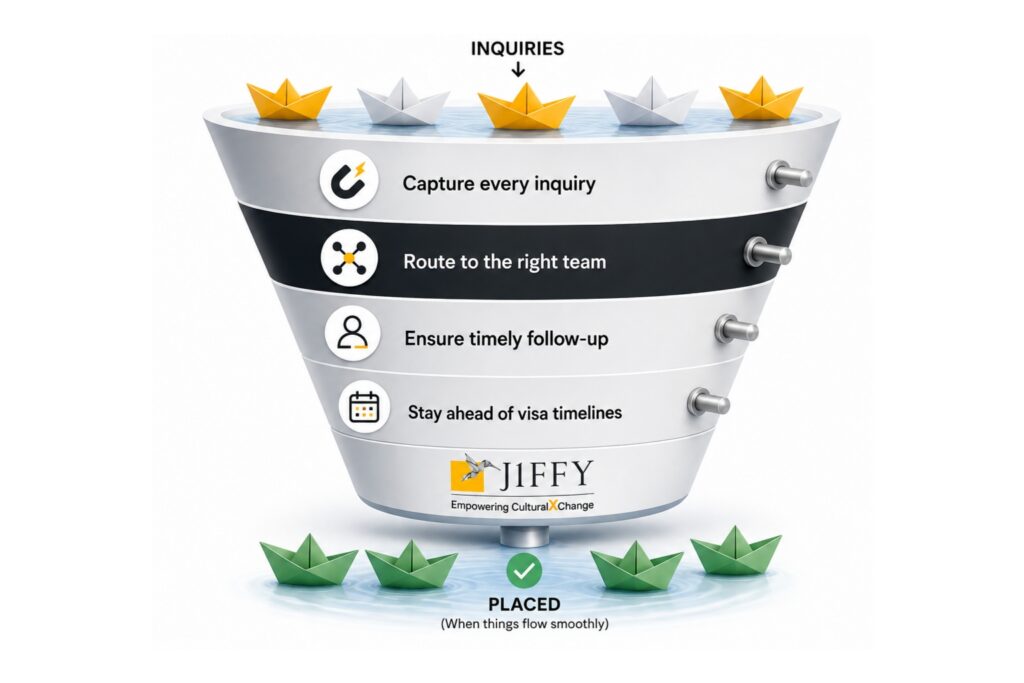
The same staff who handled 200 applicants in April are suddenly handling 500 in June. This is exactly where J1FFY helps, giving the same team a system built to handle five times the volume without five times the chaos That’s not a headcount problem; it’s a process that was never built for the surge, and adding a few temporary hires won’t fix the math. Temporary hires also need training, and training takes time you don’t have once the rush has already started.
Agencies that get through peak season without the scramble do a few things differently:
- Applicants who know upfront how long responses take are far less likely to ghost. Set expectations with applicants upfront. Let them know how long responses typically take. A normal delay feels very different from being ignored.
- One rule everyone follows: every inquiry gets a reply within 24 hours. Track it. Don’t leave it in memory.
- Every applicant should have a named owner, not a shared inbox everyone dips into. One person is responsible for moving things forward.
- The pipeline needs a daily check, not just a reaction when an applicant complains. A quick daily review catches a stuck application before it becomes a lost one.
- Last year’s numbers are worth checking before the season starts. If your team handled 200 applicants in April and 500 in June, plan workload around that pattern instead of getting caught off guard by it again.
- Hand every applicant a document checklist on day one. List exactly what you need, passport copy, reference letters, valid license, DS-2019 supporting documents and the format for each, so staff aren’t sending five separate follow-up emails per file once volume spikes.
- A short debrief after each peak season. Write down what broke while it’s still fresh, so next year you’re fixing new problems instead of the same old ones. With J1FFY, nothing depends on memory or a scattered spreadsheet in the first place, so there’s nothing missing to piece back together.All of this is manageable when applicant volume is modest. It gets much harder to hold once the numbers multiply, and everyone on the team is already at capacity.
What It Costs You If You Don't Fix This
Picture the same recruiter three months later. The lead who never received a reply is now placed through a competitor who responded in two days. Now imagine an agency processing 200 leads a month during peak season. A 10% drop-off from unanswered inquiries, missed follow-ups, and unclaimed leads means losing 20 leads each month. Across a three-month peak season, that adds up to 60 lost leads. If each of those leads would have become a placement worth $1,500 in fees, the agency could leave up to $90,000 on the table, not because the leads weren’t there, but because nobody followed up in time.
What It Looks Like Fixed
Now picture the fixed version. The lead gets a reply within a day, because one person owns the file from the start. J1FFY works with exchange agencies to fix exactly this, leads scattered across channels with no clear owner and no visibility into where an applicant is stuck.
Peak season isn’t going away, and next year’s J-1 visa processing delays will likely be worse, not better. The agencies that come ahead aren’t the ones working harder in July. They’re the ones who spent April preparing for it.
Book a demo with J1FFY and see what peak season looks like when it isn’t costing you revenue or applicants.